Very rarely has any person in history
“mastered a profession”
as a rookie.
Norman Adams did just that: he had
mastered the profession of Commercial Art as a rookie.
And
he did all this in the highest
paid profession at the time.
And
all this was obvious to the professionals of Commercial Art;
professionals like Charles
Cooper (Charles E Cooper Studios) Bill Erlacher (Artists
Associates) and Robert
Fawcett.
And they were right, because Norman Adams'
versatility allowed him to be a success for more than three decades
after the “art” in his profession had melted into the
field of Advertising.
As a rookie
Norman Adams not only went straight into the big-league of Commercial
Art
as a rookie he was an “all-star.”
And he did far more. More than probably any other
artist: his wildlife paintings
that appeared on Hunting, Fishing
and Outdoor magazine covers in the 1960-70s
were so successful in
entertaining the public...
the popularity of these magazines in
turn helped trigger
a whole new movement in art: Wildlife Art.
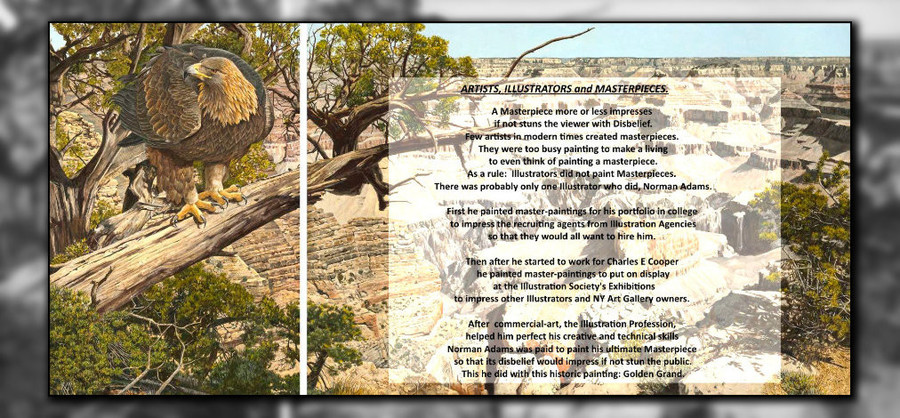
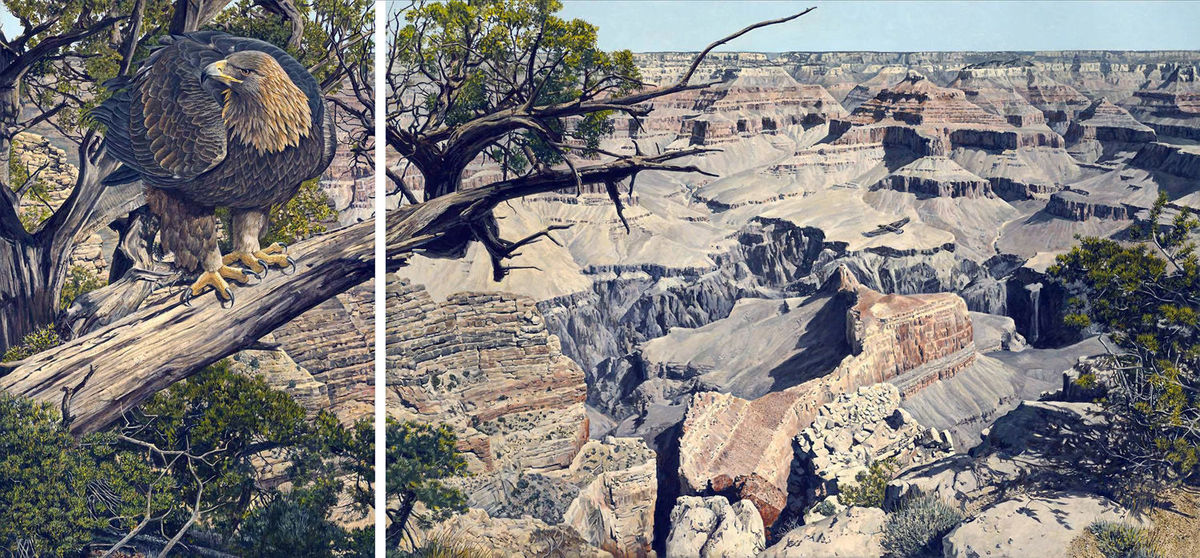
Norman Adams' two-piece “Golden-Grand” won Best of Show at the 1988 Minneapolis International Wildlife Art Show.
Move over Norman Rockwell — Walla Walla’s Norman Adams was an award-winning and nationally renowned artist and illustrator who made his mark in the art world and returned home by choice. And in the Valley, his artistic horizons expanded into the wildlife art he’s best known for.
Fred Norman Adams was born to Fred and Katherine (Schwarz) Adams in Walla Walla on Oct. 3, 1933. In 1909, Katherine’s father, Adolph Schwarz, had become the major stockholder and vice president of the newly formed Walla Walla Brewing Company, located on Second Street.
In 1940, the Adams family was living at 377 S. Third St., on the same city block as the brewery. This was the home Norman returned to when he came back to Walla Walla in 1976.
From an early age, Fred and Katherine’s son, who went by his middle name, showed a keen interest in painting, although his first creative endeavor (at age 5) was to paint the family car. All of it. Unsurprisingly, Norman’s father became his first critic.
Undeterred, Norman began collecting pictures from magazines and books, often using them as models for his own drawings and paintings. He was particularly fascinated with trompe l’oeil artists like William M. Harnett and John F. Peto. (Trompe l’oeil is a painting or design intended to create the illusion of a three-dimensional object.) This was one of the genres Adams utilized during his substantial career.
After graduating from Walla Walla High School in 1951, Adams attended the University of Washington. Finding the school was not a good fit for his artistic interests, he completed his education at the Art Center School in Los Angeles (now the ArtCenter College of Design in Pasadena).
After college, he decided New York City was the best place to pursue a career in art, and went east in 1959. After seeing his extensive portfolio, three large agencies wanted to hire him as an illustrator. Adams chose the renowned Charles E. Cooper Studio, where he was able to work on a wide variety of illustrations for magazines such as The Saturday Evening Post, Reader’s Digest, Boys’ Life, Field & Stream and Business Week, to name a handful.
Although Adams did a portrait of Lyndon B. Johnson for the cover of True magazine, his most famous cover was on the July 19-26, 1969, TV Guide, featuring the moon landing. In a July 24, 1969, article in the Walla Walla Union-Bulletin, Adams recalled meticulously depicting the special TV camera used on the moon for the cover. NASA had reluctantly agreed to loan him one of the two cameras in existence, and he noted “they were very much concerned about how well I’d take care of it, and I must have had a dozen calls that day about how careful I was being, and when I’d return it.”
Adams also illustrated numerous book covers, everything from mysteries (including a Dashiell Hammett series and Ngaio Marsh mysteries) to a number of westerns. He was given the Raven Award by the Mystery Writers of America for his imaginative cover illustrations. The award recognizes outstanding achievement in the mystery field, outside the realm of creative writing.
Adams enjoyed a successful career in New York, where he and his wife Lee (Van Zwienen) hobnobbed with some of the most prominent artists of the time, including Andy Warhol. But Adams longed for his hometown, and he and Lee moved to Walla Walla in 1976. It was at home that his transition from illustrator to wildlife artist came to fruition. It included an expansion from the illustration genre practiced in the Cooper Studio to working in oils. His approach was to apply thin layers of paint.
“It’s time-consuming, but I’m comfortable with it,” he said. “I think the translucency of the painting — the effect between the oil and the light, creates depth, which is one of the things I’m trying to achieve — depth in the surface of the painting.”
Adams soon gained a national reputation for his wildlife paintings — many of which were set in the Walla Walla Valley. His work features realistic works that seem to jump off the canvas.
In 1980, Lenox hired him to do a very limited edition of 12 American Wildlife Plates, and in 1992, he was commissioned to produce a series of stamps for the United Nations, featuring endangered species. He also illustrated “The Birds and Birdlore of Samoa” (1982), written by Walla Wallans Shirley and Corey Muse.
With Joe Singer, Adams in 1989 published “Drawing Animals,” which, judging by online reviews, is still considered an excellent reference on the subject. In the introduction he states: “To draw an animal well it is necessary to know and understand its personality and behavior in order to express its individual features.” The book includes detailed drawings of North American and African animals.
In 1987, Adams and his friend Geza Palotas attended an exhibit of wildlife art by Robert Bateman at the Smithsonian National Museum of Natural History in Washington, D.C. Although Bateman is considered a pre-eminent wildlife artist, Adams was disappointed to see his work lacked detail when viewed up close.
Bateman — like many illustrators — dispensed with a high level of detail, since the illustrations were designed to be reduced in size for publication. Adams’ work, on the other hand, is finely detailed. Although it was not necessary for many of his commissions, he felt compelled to include minute details in his compositions.
After their visit to the Bateman exhibit, Palotas commissioned Adams to paint “the most impressive painting he could, so we could take it to the 1988 Minneapolis International Wildlife Art Show.”
In 1988, Adams submitted a pair of paintings to the show, one featured a golden eagle perched on a branch over the Grand Canyon. The companion painting, exhibited next to the eagle, extended the two-part “Golden Grand” into a panorama of the canyon. Palotas remembers, “More than one viewer insisted vehemently that it was a photograph ... others, especially kids, just stared, waiting for the life-size eagle to move.” “Golden Grand” won Best of Show.
Because Adams’ approach produced complete works that stood in their own right, his art was often included in gallery shows. Major exhibits of his work included Crossroads of Sport; New York: 200 Years of American Illustration; and a number of pieces showcased at the Society of Illustrators of Los Angeles show in California.
Adams’ works are in a number of private collections and at the Department of the Interior. In 1989, several of his murals were installed at Whitman Mission National Historic Site, including one of a solitary deer in the site’s native ryegrass and one depicting seasonal life at the Mission.
Adams was enthusiastic about his locally focused works. He branched out into paintings portraying the early history of the Walla Walla Valley, including Lewis and Clark and the fur trade. He also did a series of paintings that appeared on posters for the annual Fort Walla Walla Rendezvous. His historical paintings also grace the covers of author Bill Gulick’s four-part regional history series “Roll on Columbia.”
In 1989, Adams contributed his wildlife stamp of Columbia Basin chukars for a poster to benefit Blue Mountain Audubon. Always busy, he also painted a number of works of dogs and horses, and was quite willing to create images of people’s homes. He produced a unique series of paintings for Jim McGuinn, owner of local record store Hot Poop, that are still available on T-shirts.
Adams loved to paint, and left few opportunities on his easel, remaining active almost until his death on July 4, 2014.
Today, Adams is remembered fondly by those who knew him, for the warmth of his personality and his devotion to his art and the Walla Walla Valley. Fortunately for the community, he donated much of his artwork to Fort Walla Walla Museum, which now holds a large collection, including a wide variety of paintings and illustrations.
This Walla Walla native, who gained national and international acclaim but never lost his love for his hometown, is a beloved and distinguished son of the Valley.
© Walla Walla Union-Bulletin 2016 – Diane Reed, Jun 26, 2016
-=-
Bill
Erlacker's DREAM TEAM
of
the best of the very best Professional Artists:
ARTISTS ASSOCIATES, 1963-2000
Norman Adams on... Facebook … Flickr and Charles E Cooper's Babe Ruth Story
Artists and their Masterpieces